
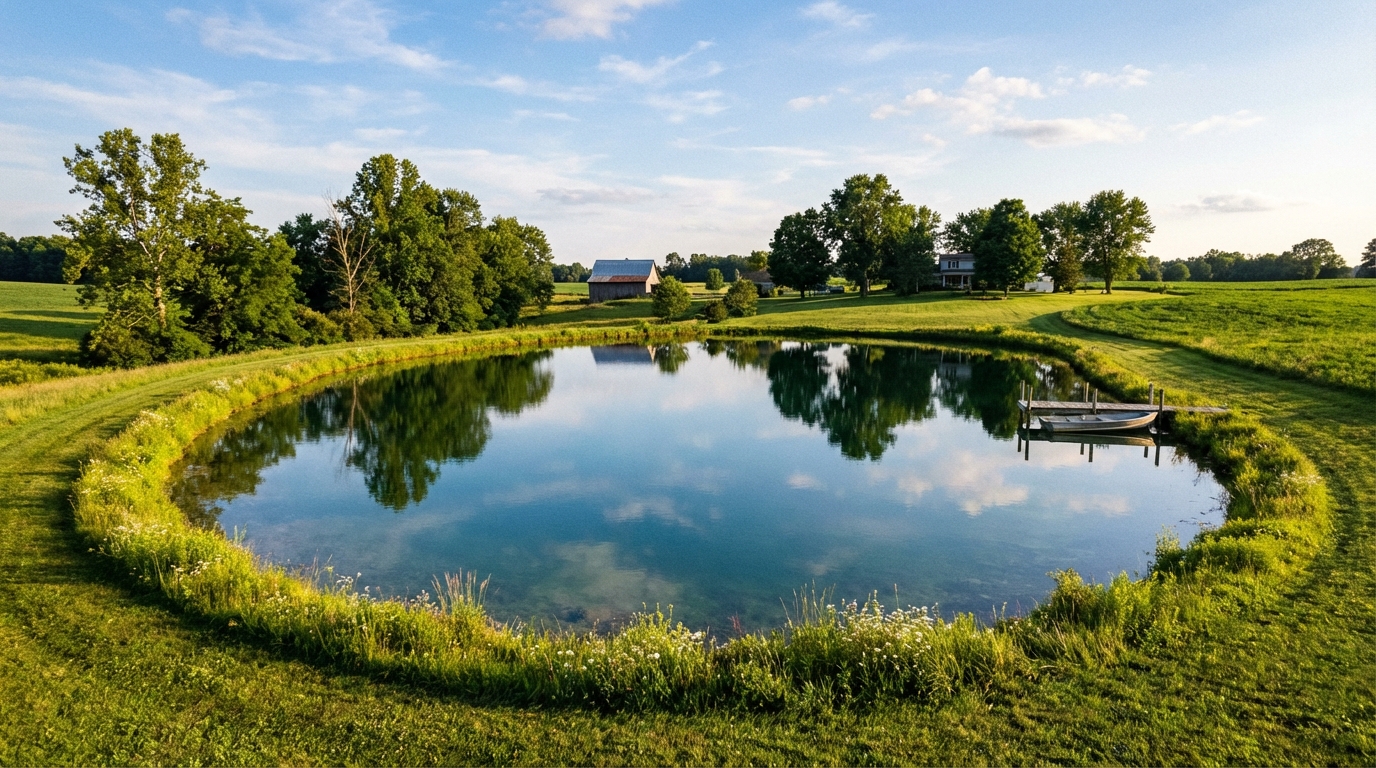
Why Build a Farm Pond?
A well-constructed farm pond is one of the most versatile improvements you can make to a rural property in Southwest Ohio. Beyond the obvious aesthetic appeal, a pond can serve as a reliable water source for livestock, an irrigation reservoir for crops and gardens, a recreational feature for fishing and swimming, a fire suppression resource, and a wildlife habitat that enhances the ecological value of your land.
For many landowners across Clinton, Highland, and Warren counties, a pond also increases property value significantly. A half-acre pond on a well-maintained property is a selling point that buyers actively seek out.
Step 1: Site Selection
Choosing the right location is the single most important decision in pond construction. Here’s what to evaluate:
Topography. The ideal pond site has a natural low point or depression with gently sloping terrain feeding water into it. A valley between two ridges creates a natural dam site that minimizes excavation costs.
Watershed Area. Your pond needs enough land draining into it to keep it full. A general rule of thumb for our area is 4-6 acres of watershed per surface acre of pond. Too little watershed means a pond that stays low; too much creates overflow management challenges.
Soil Type. Southwest Ohio’s clay soils are generally excellent for holding water. The red and gray clays found throughout Clinton and Highland counties provide a natural seal. Sandy or gravelly soils may require a clay liner or synthetic membrane, which adds cost.
Distance from Structures. Keep ponds at least 50-100 feet from buildings and septic systems. Check with your local health department and zoning office for specific setback requirements.
Step 2: Understand Ohio Regulations
Ohio regulates dams and impoundments through the Ohio Department of Natural Resources (ODNR). Here’s what you need to know:
- Class I Dams: Most farm ponds fall below the regulatory threshold, but if your dam exceeds 6 feet in height with a storage capacity over 15 acre-feet, or 10 feet in height with any storage capacity, you may need a permit from ODNR.
- Wetlands: If your proposed site includes or borders wetlands, you’ll need to consult with the US Army Corps of Engineers regarding Section 404 permits.
- Local Zoning: Some townships in Clinton, Highland, and Warren counties have their own setback and construction requirements. A quick call to your county zoning office can clarify what applies to your property.
Step 3: Design Considerations
Depth. We recommend a minimum depth of 8-10 feet for ponds that will support fish. This ensures a cool, oxygenated zone that survives Ohio’s hot summers and prevents winter kill from ice cover. Shallow ponds are prone to excessive weed growth and algae problems.
Shape. Irregular, natural-looking shapes blend better with the landscape and create more interesting shoreline habitat. Avoid perfectly round or rectangular shapes — they look artificial and can develop circulation dead zones.
Shelves and Slopes. A shallow shelf around the perimeter (2-3 feet deep, 6-8 feet wide) provides safety, supports aquatic plants, and creates habitat for bass and bluegill spawning. Bank slopes should be no steeper than 3:1 (three feet horizontal for every foot vertical) for stability and mowing access.
Spillway. Every pond needs a spillway to safely handle overflow during heavy rains. An undersized or poorly positioned spillway is the number-one cause of dam failure. We design spillways to handle the 25-year storm event or greater, depending on the downstream risk.
Step 4: Construction
Pond construction in Southwest Ohio typically follows this sequence:
- Clear the site — Remove trees, brush, and topsoil from the dam footprint and pond basin.
- Core trench — Excavate a key trench along the dam centerline down to impervious clay, creating a watertight bond between the dam and the native soil.
- Dam construction — Build the dam in 6-8 inch lifts, compacting each layer to 95% or greater density. This is the most critical step — a poorly compacted dam will leak.
- Spillway installation — Construct the primary spillway (usually a pipe through the dam with a riser) and the emergency spillway (a graded channel around one end of the dam).
- Basin shaping — Grade the pond bottom to achieve target depths, create shelves, and establish proper slopes.
- Finish work — Grade and seed all disturbed areas, install any fencing, and establish erosion control measures.
What to Expect: Costs
Pond construction costs in our area typically range from $3,000 to $8,000 per surface acre for straightforward projects with favorable soil conditions. Factors that increase cost include poor soil requiring clay import, difficult access, rock encountered during excavation, and complex dam or spillway designs.
A quarter-acre fishing pond on a good clay site with reasonable access might run $5,000-$10,000. A full-acre pond with a significant dam could be $12,000-$25,000 or more. Every site is different — a free on-site evaluation is the only way to get an accurate number.
After Construction: First-Year Management
Patience is key. Your pond will look like a muddy hole for the first few months. Here’s what to expect and do:
- Filling: Most ponds in Southwest Ohio begin filling immediately and reach full pool within 3-6 months with normal rainfall.
- Seeding: The dam, banks, and disturbed areas should be seeded immediately after construction and protected with erosion blankets on slopes.
- Mowing: Once grass establishes, maintain it by mowing the dam and banks regularly to prevent woody growth that can damage the dam.
- Fish stocking: Wait until the pond is at or near full pool and has some vegetation established — typically 6-12 months. Contact the Ohio Division of Wildlife for stocking recommendations.
Ready to Build Your Pond?
If you’ve been thinking about adding a pond to your Southwest Ohio property, we’d love to talk through the possibilities. With over two decades of pond construction experience across Clinton, Highland, Warren, and Brown counties, we know the local soils, regulations, and techniques that lead to successful, long-lasting ponds.
Contact Earthwise Excavating today at (513) 212-7585 or request a free consultation. We’ll visit your property, evaluate the site, and give you an honest assessment of what’s possible — and what it will cost.