
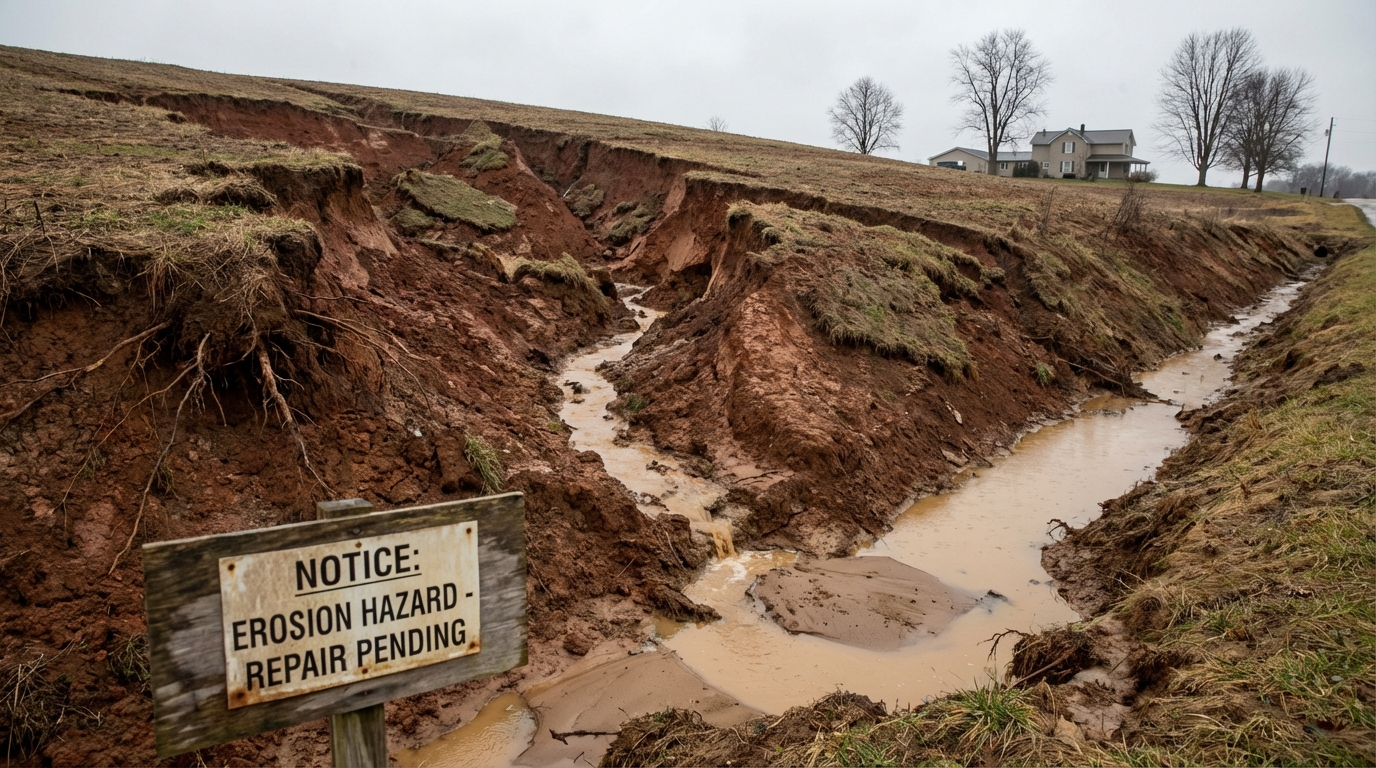
Why Erosion Matters More Than You Think
Erosion is one of those problems that starts small and gets expensive fast. A little rill in your yard after a hard rain doesn’t seem like much — until it becomes a three-foot gully eating into your hillside, undermining your driveway, or depositing mud across your neighbor’s property.
In Southwest Ohio, our combination of clay soils, rolling terrain, and significant rainfall (40+ inches annually) creates conditions where erosion can accelerate quickly once it starts. The good news is that most erosion problems are preventable, and even severe damage can be repaired with the right approach.
Common Causes of Erosion in Southwest Ohio
Understanding why erosion occurs is the first step toward stopping it. Here are the most common causes we see on properties across Clinton, Highland, and Warren counties:
Concentrated Water Flow
When rainwater is funneled into a single path — by a downspout, a ditch, a road, or a natural valley — it picks up speed and cutting power. A gentle sheet of water flowing across a field is harmless. That same volume concentrated into a channel can carve through clay soil at an alarming rate.
Disturbed Soil Without Cover
Any time soil is exposed — from construction, grading, tilling, or even animal traffic — it becomes vulnerable. Bare soil has no root structure to hold it in place and no vegetation to absorb the impact of raindrops. In our area, a single heavy thunderstorm can remove inches of topsoil from an unprotected surface.
Improper Grading
When land is graded without proper attention to water flow, the results can be devastating. Water that’s directed toward a hillside edge, a foundation, or an unprotected slope will find the path of least resistance — and create its own channel in the process.
Loss of Vegetation
Whether from overgrazing, tree removal, drought, or herbicide application, losing ground cover opens the door to erosion. In Southwest Ohio, fence rows and waterway buffers that have been cleared are particularly prone to rapid erosion.
Warning Signs to Watch For
Catch erosion early and the fix is usually simple and affordable. Let it go, and you’re looking at a major excavation project. Watch for these signs on your property:
- Rills and channels forming after rain, especially on slopes or near construction areas
- Sediment deposits at the bottom of slopes, on driveways, or in ditches
- Exposed roots on trees and plants where soil has washed away
- Undermined structures including foundations, retaining walls, patios, and fence posts
- Standing water in new areas where it didn’t collect before
- Muddy water running off your property into roads or neighboring land
- Cracking or slumping on hillsides, which can indicate subsurface water movement
Practical Solutions
For Minor Erosion
Vegetative Cover. The simplest and most cost-effective erosion control is healthy grass. If you have bare areas, seed them immediately with an Ohio-adapted erosion control mix. Hydroseeding is particularly effective on slopes because the mulch in the slurry protects the seed while it germinates.
Straw or Erosion Blankets. For temporary protection on freshly seeded areas, straw mulch (applied at 2 tons per acre) or manufactured erosion blankets hold soil in place until vegetation establishes.
Rain Garden or Buffer Strip. Planting a strip of dense, deep-rooted vegetation at the base of a slope or along a drainage path slows water, filters sediment, and encourages infiltration.
For Moderate Erosion
French Drains. A trench filled with gravel and perforated pipe intercepts subsurface water before it reaches the surface and causes problems. French drains are especially effective along the base of hillsides and near foundations.
Surface Swales. A shallow, grass-lined channel directs water across a slope at a gentle grade, preventing it from picking up speed and cutting a gully. Swales are one of the most effective and natural-looking solutions for hillside properties.
Regrading. Sometimes the most effective fix is to regrade the area to eliminate the conditions causing erosion. Proper grading directs water away from structures and into appropriate drainage channels at safe velocities.
For Severe Erosion
Gully Repair. Large gullies require filling with compacted material, regrading, and installing drainage to prevent recurrence. This is not a DIY project — heavy equipment is needed to do it right and make it last.
Retaining Structures. In severe cases, rip-rap (large stone), gabion baskets, or engineered retaining walls may be needed to stabilize slopes that have failed or are at risk of failure.
Comprehensive Drainage Redesign. When erosion is widespread or recurring, the root cause is usually a systemic drainage problem. A comprehensive approach that addresses water management across the entire property is the only lasting solution.
The Conservation Approach
At Earthwise Excavating, we approach erosion control as an integral part of every project we do — not an afterthought. When we grade a building pad, we plan the drainage. When we clear land, we seed the disturbed areas. When we build a driveway, we install the culverts and ditches that keep it intact through heavy rains.
This proactive, conservation-focused approach costs a little more upfront but saves dramatically over time. Emergency erosion repair is always more expensive than prevention.
When to Call a Professional
If erosion is actively threatening a structure, undermining a road or driveway, depositing sediment on neighboring properties, or if the damage is too large to address with hand tools and seed, it’s time to bring in equipment. The longer you wait, the worse it gets and the more it costs to fix.
Ready to address erosion on your property? Contact Earthwise Excavating at (513) 212-7585 or request a free property assessment. We’ll identify the problem, recommend the most cost-effective solution, and get your land stabilized.