
Before the Builder Shows Up
Building a new home on rural land in Southwest Ohio is an exciting project — but the work that happens before your builder ever breaks ground is what determines whether that project goes smoothly or becomes a budget-busting headache.
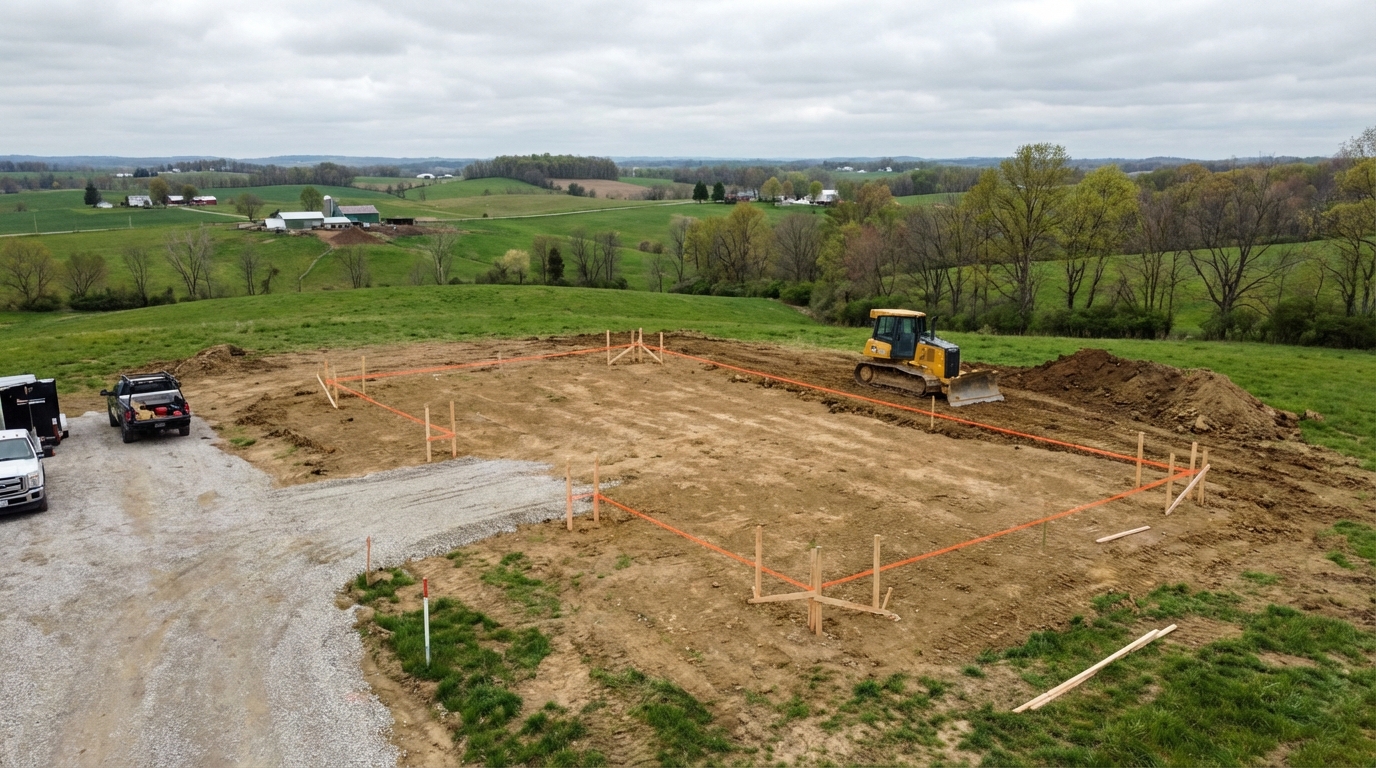
Site preparation is the foundation work beneath the foundation. It includes clearing, grading, utility access, drainage planning, and soil management. Get it right, and your builder has a clean, stable surface to work from. Get it wrong, and you’ll be dealing with water in your basement, cracking foundations, and eroding hillsides for years to come.
Here’s what you need to know.
Start with a Site Assessment
Before you commit to a building location on your property, invest in a thorough site assessment. This isn’t just walking the land and picking the spot with the best view (though the view matters). A proper assessment evaluates:
Soil Conditions. Southwest Ohio’s soils vary significantly even within a single property. Clay content, rock depth, organic layers, and load-bearing capacity all affect foundation design and construction costs. A soil bore test or percolation test can reveal what’s below the surface.
Drainage Patterns. Walk your property during and after a heavy rain. Where does water flow? Where does it collect? Building in a natural drainage path is asking for trouble. Understanding existing water patterns before grading helps you work with the land rather than against it.
Access. Your building site needs to be accessible not just for your daily commute, but for concrete trucks, lumber deliveries, and heavy equipment. Steep grades, narrow paths, and soft ground can dramatically increase driveway and access costs.
Utilities. Where are the nearest electrical, water, and sewer or septic connections? Long utility runs add cost. If you’re on a well and septic system (common in rural Clinton and Highland counties), the building site needs to accommodate both the house and the septic field with proper separation distances.
Clearing: More Than Cutting Trees
If your building site has trees, brush, or other vegetation, clearing is the first physical step. But clearing isn’t just about removing what’s in the way:
- Preserve mature trees that provide shade, windbreak, or aesthetic value. A 50-year-old oak near your future home is an asset — mark it for preservation before the equipment arrives.
- Remove stumps and roots from the building footprint and driveway alignment. Buried organic material decomposes and creates voids that cause settling.
- Stockpile topsoil separately from subsoil. You’ll want that topsoil back later for final grading, landscaping, and seeding.
- Manage debris properly. Burning regulations vary by township in our area, and buried wood waste causes long-term settling problems.
Grading: The Most Important Step
Grading establishes the elevation and contour of your building site, and it has more impact on the long-term performance of your home than almost any other construction step. Here’s what proper grading accomplishes:
Positive Drainage Away from the House
The finished grade around your home must slope away from the foundation in all directions — a minimum of 6 inches of fall in the first 10 feet is the standard recommendation. This prevents water from pooling against the foundation and finding its way into your basement or crawl space.
Level Building Pad
Your builder needs a flat, compacted surface to set forms and pour footings. Even small variations in elevation can require expensive corrections during foundation work. A properly graded building pad saves time and money during construction.
Driveway Integration
Your driveway grade needs to work with your building pad elevation and the road connection. Planning these together during the grading phase prevents the costly rework of cutting or filling a driveway that doesn’t match the house elevation.
Stormwater Management
Ohio requires construction sites to manage stormwater runoff and prevent sediment from leaving the property. Your grading plan should include temporary erosion control measures (silt fence, stabilized construction entrances) and permanent drainage features (swales, ditches, culverts) that protect your property and keep you in compliance.
Common Mistakes to Avoid
Having worked on hundreds of building sites across Southwest Ohio, we see the same mistakes repeated:
-
Skipping the soil test. Building on uncompacted fill, organic soil, or over a hidden spring leads to foundation failure. A $500 soil test can save $50,000 in repairs.
-
Cutting into hillsides without drainage planning. Every cut slope becomes a water collector. Without proper drainage behind retaining structures and at the base of cuts, hydrostatic pressure builds and things start moving.
-
Building on the lowest point of the property. Low areas collect water — that’s their job. Building there means fighting gravity permanently. Choose a slightly elevated site even if it requires more grading.
-
Ignoring the driveway until last. Driveway grade, width, and drainage need to be planned alongside the building pad, not as an afterthought. A steep driveway that ices over every winter or washes out every spring makes for a miserable experience.
-
Not seeding disturbed areas promptly. Every day that bare soil sits exposed is a day erosion can do damage. Seed and mulch disturbed areas as soon as work in that zone is complete.
Working with Your Builder and Excavator
The best results come from early coordination between you, your builder, and your excavation contractor. At Earthwise Excavating, we prefer to be involved in the planning phase — reviewing foundation plans, discussing utility locations, and evaluating the site together before breaking ground.
This collaborative approach identifies potential problems early, when they’re cheap to solve, rather than mid-construction when they’re expensive.
The Earthwise Approach
Every building site we prepare reflects our conservation-focused philosophy. We don’t just move dirt — we manage the land responsibly:
- We preserve existing trees and natural features wherever possible
- We stockpile and return topsoil for final grading
- We install erosion control measures before, during, and after construction
- We plan drainage that works with the natural terrain
- We seed all disturbed areas to stabilize soil
This approach creates building sites that are not just level and stable, but respectful of the land they’re built on.
Ready to Prepare Your Building Site?
If you’re planning to build on rural land in Southwest Ohio, start the conversation early. The sooner we can evaluate your site and discuss the grading and drainage plan, the smoother your entire construction project will go.
Contact Earthwise Excavating at (513) 212-7585 or request a free site evaluation. We serve Clarksville, Wilmington, Hillsboro, Blanchester, Sabina, and communities throughout the region.